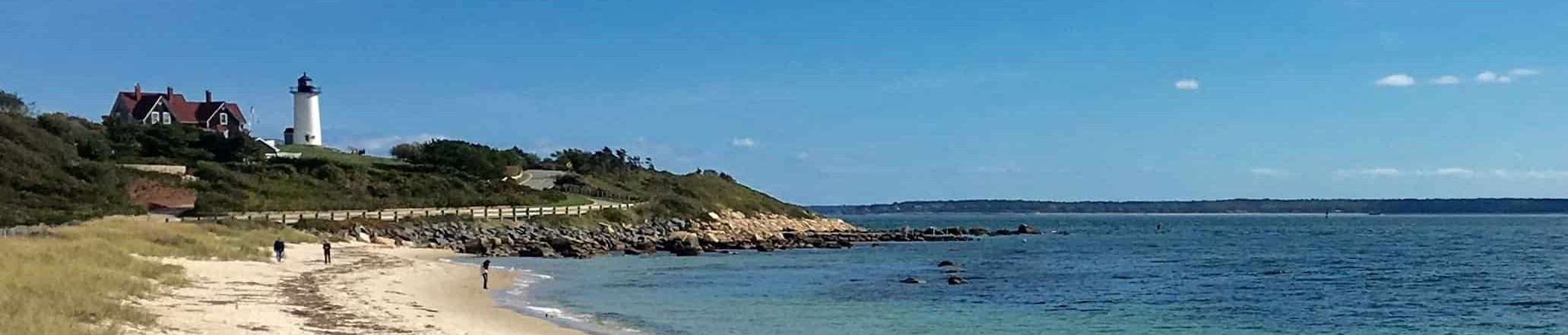
Cape Cod is located in the southeastern part of Massachusetts. It is a sandy, hooked peninsula that extends 65 miles (105 km) into the Atlantic Ocean and has a breadth of between 1 and 20 miles (1.6 and 32 km). It is bounded by Cape Cod Bay (north and west), Buzzards Bay (west), and Vineyard and Nantucket sounds (south).

In 1914, the Cape Cod Canal was built to primarily save the lives of mariners. It is a man-made waterway that cuts across the base of the peninsula, separating it from the Massachusetts mainland. The canal is 17.5 miles (28 km) long, 500 feet (152 meters) wide, and has a minimum depth of 30 feet (9 meters).
Before the canal was built, ships had to navigate around the treacherous waters of the Cape Cod peninsula, especially through the shallows near Provincetown. Storms, strong currents, and rocky coastlines posed significant risks to vessels.
To actually reach Cape Cod, twin highway bridges were built over the canal: namely the Sagamore Bridge and the Bourne Bridge. Replacing a previous drawbridge, both bridges were constructed beginning in 1933 and opened to traffic on June 22, 1935. They both carry four lanes of traffic (two in each direction), have a total length of 1,408 feet (429 m), and a width of 40 feet (12 m).
The highest point of each bridge stands at 275 feet (83.82 meters) above the water and has a ship’s clearance of 135 feet (41 m).
Sagamore Bridge

Bourne Bridge

Cape Cod Canal Railroad Bridge
In addition to the highway bridges, the Cape Cod Canal Railroad Bridge was built to carry railway freight and limited passenger service onto the Cape. The Cape Cod Railroad bridge is a vertical lift bridge, which means that the center span lifts up and down. The 2,200-ton center span is counter-weighted with a 1,100-ton concrete filled steel-plated box that hangs in both towers. The span is connected to the counterweights by 40 steel cables.

Cape Cod’s historic, maritime character and ample beaches attract heavy tourism during the summer months. Cape Cod officially opens for tourism on Memorial Day and closes on Labor Day. Visitors often plan their visit by reaching out to the Cape Cod Chamber of Commerce to obtain a Cape Cod Travel Guide.
The Cape Cod National Seashore (CCNS) encompasses 43,607 acres (68.1 sq mi; 176.5 km2). CCNS was created on August 7, 1961, by President John F. Kennedy, when he signed a bill enacting the legislation he first co-sponsored as a Senator a few years prior. The CCNS includes nearly 40 miles (64 km) of protected seashore along the Atlantic-facing eastern shore of Cape Cod.
Nantucket Island
Nantucket is located in the Atlantic Ocean about 30 miles (48 km) south of Cape Cod, across Nantucket Sound. It is of glacial origin and has wide, sandy beaches, a spacious harbor, and a moderate climate.
Only accessible via boat or plane, the most common mode of transport to the island is by high-speed ferry with a travel time of 1 hour. Car-and-passenger ferries are also available with a travel time of 2.15 hours.
Nantucket has 82 miles of beaches and is 14 miles wide and 3-5 miles long. The island is about 47.8 square miles. It is normally 10 degrees warmer than Cape Cod during the winter and 10 degrees cooler in the summer due to its proximity to the Gulf Stream.
The year-round population Nantucket is approximately 14,255 people. During the summer months, the population swells to around 80,000 people.

Martha’s Vineyard
Martha’s Vineyard is located 15 miles (24 km) west of Nantucket Island. Similar to Nantucket, the only way to get to Martha’s Vineyard is via plane or ferry. Transport via ferry, the most common mode, takes approximately 45-50 minutes.
The year-round population of Martha’s Vineyard is approximately 15,000 people, spread across six towns: Edgartown, Oak Bluffs, Tisbury (Vineyard Haven), West Tisbury, Chilmark, and Aquinnah (formerly Gay Head). During the summer months, the island can host as many as 200,000 visitors.

Despite its name, there are no actual vineyards on Martha’s Vineyard. British sailor Bartholomew Gosnold named the island after his daughter, Martha, and the vine-like growth found along the coast.
Although having no vineyards, numerous microbreweries dot the island where local beer and fine dining can be enjoyed. Grab yourself a Visitor’s Guide to Cape Cod & The Islands and have the experience of your lifetime. With the sea and sand under your feet and a local beer accompanying the fresh catch-of-the day, you’ll want to return again and again.